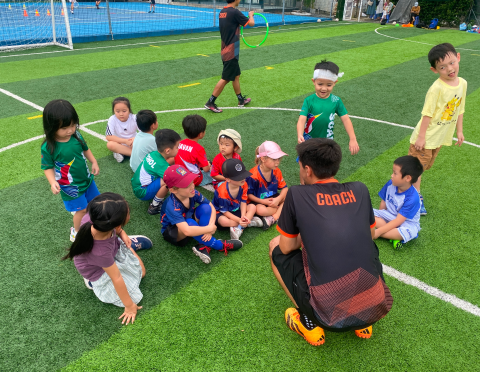
Every parent wants to raise a confident, disciplined, resilient child. Football, when coached well, is one of the most reliable ways to build all three. Here’s what the research actually says about how kids’ football develops character — and how the right academy turns the science into something your child can feel.
Why team sport changes a child more than individual practice ever will
Most parents start out asking, “is football the right sport for my kid?” The more interesting question is, “what does any structured team sport do to a developing child that solo activities don’t?” The research on this is fairly settled, and it’s striking.
A long-running body of work in developmental psychology — including studies by the American Academy of Pediatrics and the UK’s Sport England — finds that children who participate in regular team sport from age 5 onwards score higher on measures of self-regulation, prosocial behaviour, and resilience after setbacks than peers who don’t. The effect is independent of family income, school type, and academic ability. In other words: team sport itself is doing the work.
Football has some unique advantages in this conversation. It’s the most-played team sport in the world, which means kids find peers everywhere. It’s continuous (not turn-based like baseball or cricket), which trains constant decision-making. And it has a forgiving learning curve — most children can dribble a ball within a few weeks of starting, which produces the early wins that fuel longer commitment.
Confidence: how kids build it on a football pitch
Confidence in children isn’t about telling them they’re great. It’s about giving them repeated, age-appropriate experiences of doing hard things and noticing they did them. A football pitch is engineered for this:
- The first goal in a small-sided game — a tangible, public win.
- Receiving a pass under pressure and not losing the ball — a quieter, internal one.
- Coming back into the game after being tackled hard — possibly the most important one.
- Being trusted to take a free kick or penalty — a teammate-mediated vote of confidence that no parent can replicate.
What you’ll see in your child after a good football term: they speak up more in unfamiliar settings. They take small physical risks (the rope swing, the new bike, the swim across the pool) more readily. They ask to do things by themselves. This isn’t anecdote — it’s a well-documented carry-over effect from regular team sport, and it’s one of the things parents tell us about Fox Football most often.
Discipline: not the kind you might expect
The word “discipline” makes people think of strictness — sit still, don’t talk, do as you’re told. The discipline football teaches is the better kind: self-discipline, the kind a child carries with them when no adult is watching. It comes from internalising the rhythms of training, of doing the boring drill because it makes the exciting game possible, of arriving on time because the team needs you.
Younger kids in our Junior Division learn it through the ritual of warm-up, training, cool-down. Older kids in the Senior Division feel it in the pre-match preparation, the post-match analysis, and the consequences of not putting the work in mid-week. Children who play football consistently for 2+ years show measurably better executive function — the ability to plan, sequence and self-control — than peers who don’t, according to studies from the University of Oslo and several US-based sports development institutes.
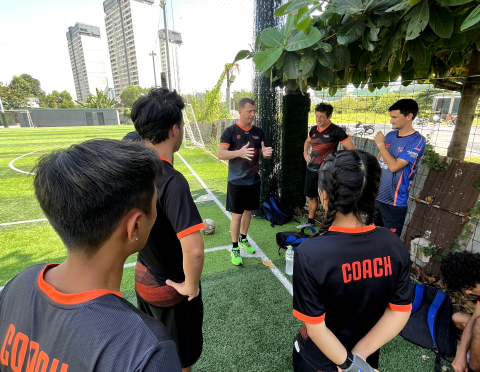
None of this requires a coach to shout. Modern, well-trained coaches build discipline through structure, expectations, and small repeated consequences — the same techniques the best primary school teachers use. The shouting-coach archetype is a relic, and a poor one. Modern coaching looks much more like teaching than military training, which is why so many of our parents say their child has become more focused at school as well as on the pitch.
Resilience: the most underrated benefit
Resilience is the ability to feel a setback, recover, and try again. It’s perhaps the single most predictive trait of life satisfaction in adulthood, and it’s terribly hard to teach in a classroom. Football teaches it weekly:
- Your team loses a game. Coach helps the team analyse why. Next week you train differently.
- You miss an open goal. The next time the ball comes to you, you have to take it again.
- You don’t get picked for the starting line-up. You see a teammate get picked. You handle it, or you don’t — and the coach is there either way.
These are small, weekly doses of “things didn’t go my way and I survived.” Children who get them regularly grow up with a different relationship to failure than children who don’t.
Social skills and friendships that last beyond the pitch
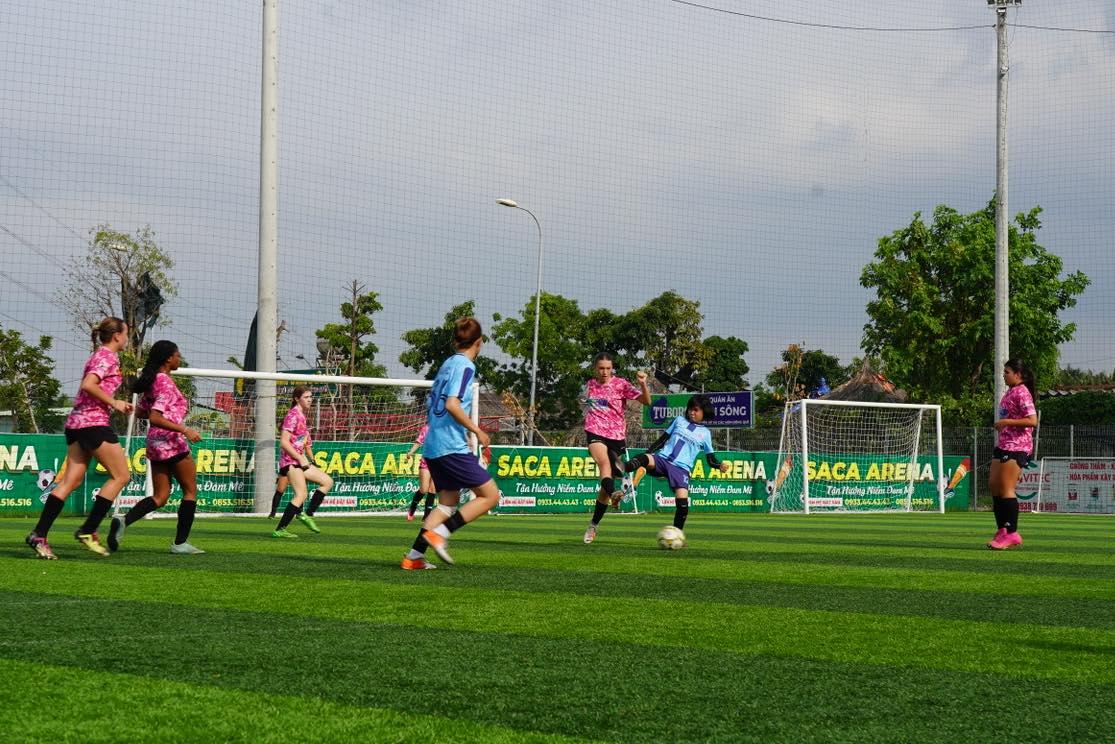
Football is intensely social. A 60-minute session involves dozens of micro-negotiations: who passes to whom, who covers when, whose turn it is, who the captain is today, who said something funny in the warm-up. Kids practise the entire human stack — empathy, leadership, follow-through, self-advocacy — in compressed form. The friendships formed at football are different from school friendships, partly because they’re built around shared physical experience rather than just classroom proximity.
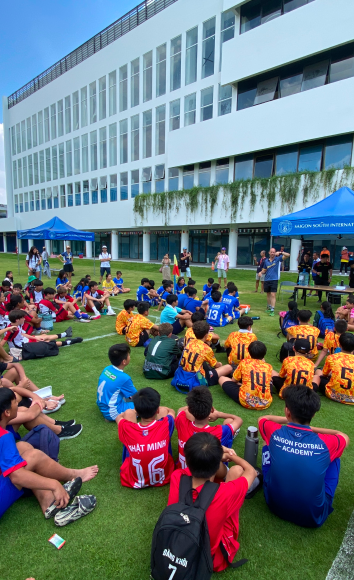
In Ho Chi Minh City, this matters even more. Many of the families we work with are international, bilingual, or moving between schools — football becomes a continuous social home that survives the changes. Vietnamese and international kids train together, build friendships, and develop a comfort across cultures that’s hard to engineer any other way.
Physical development: the layer most parents already see
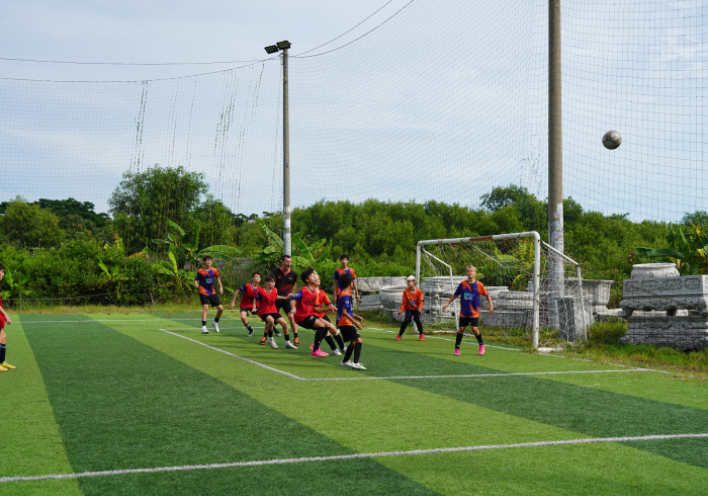
Beyond the character side, the obvious physical benefits matter too. Regular football training improves cardiovascular fitness, balance, agility, posture, and gross motor control. For HCMC-based kids especially — many of whom spend long days in air-conditioned classrooms — getting outdoors in structured movement two or three times a week is a powerful counterweight to sedentary life.
The American Academy of Pediatrics recommends children get at least 60 minutes of moderate-to-vigorous physical activity daily. Most don’t. A weekly football class won’t get you there alone, but it builds the habit and the love of movement that does the rest of the work for the next decade.
What “coached well” actually means
None of these benefits are automatic. They emerge when football is coached well — and there are clear markers:
- Coaches who know each child by name and adjust to their personality.
- Sessions where every child gets meaningful touches on the ball, not just the strongest few.
- Praise for effort and decision-making, not just goals scored.
- A culture where setbacks are framed as learning, not failure.
- Parent communication that’s specific and genuine, not performative.
This is the difference between a child who plays football for a year and shrugs, and a child who plays for five years and tells you it changed how they see themselves.
How Fox Football puts this into practice in HCMC
At Fox Football Vietnam, we’ve designed our programme around the long-term: weekly classes for ages 4 to 17, age-appropriate divisions, qualified coaches, and seasonal football events that give kids competitive experience without burning them out. Our home base in Thao Dien, Thu Duc means most HCMC families can reach us in 15–25 minutes — and our seasonal camps and school programmes mean football fits around the family week, not the other way around.
The most rewarding part of our job isn’t winning matches — it’s the messages from parents months later, telling us their child handles disappointment differently, asks to bike to a friend’s house alone, or volunteers in class for the first time. That’s what good football does to kids.
Try a free trial class — see the difference for yourself
Reading about football’s benefits is one thing. Watching your child finish their first session, sweaty and grinning, is another entirely. Fox Football offers every new player a free trial class in Ho Chi Minh City so you can see the coaching, the community, and the change firsthand.
To book, message us via the Contact page, email info@foxfootballvietnam.com, or call +84 90 520 40 73. Tell us your child’s age, any football experience, and your preferred day — we’ll handle the rest.
Frequently asked questions
How long before I see changes in my child?
Confidence and enjoyment usually show up within the first 3–4 sessions. The deeper character changes — discipline, resilience, social ease — typically develop over a full term and are clearest after about 6 months of consistent play.
What if my child isn’t naturally athletic?
Most aren’t, and that’s exactly the point. The character benefits of team sport are largest for children who don’t start out as the best athlete in the group. A good coach makes sure those kids get the right level of challenge and the right kind of wins.
Does football help kids who are shy or introverted?
Often dramatically. Shy kids find a structured social environment where the rules are clear and the social pressure is mediated by the activity itself — much easier than free-form playground time. Many of our most transformed players started as the quietest in the group.
How do I balance football with school commitments?
One session a week from age 4 is more than enough — and many studies suggest regular physical activity actually improves academic performance, not the other way around. As children grow, two sessions per week is a healthy maximum for most.