“What age should my child start football?” is the single most common question we hear from parents in Ho Chi Minh City. The honest answer is “earlier than most parents think, and later than the internet would have you believe.” Here’s how a coach actually approaches it — and how to know your child is ready.
The short answer: most kids are ready for structured football from age 4
By their fourth birthday, most children have the gross motor coordination, attention span and social awareness needed to enjoy a well-designed football session. They can run, change direction, follow a one-step instruction, take turns, and most importantly, they can have fun in a group setting without a parent at their side. That’s the readiness checklist — not technical ability, not strength, not “athleticism.”
This is why our Junior Division at Fox Football starts at age 4. The session looks nothing like an adult football training: it’s built around small-sided games, ball familiarisation, simple movement patterns, and lots and lots of touches on the ball. The goal at this age isn’t to produce footballers — it’s to fall in love with the game.
Why earlier than 4 is usually a stretch
Toddlers younger than 4 can absolutely kick a ball at the park with a parent — and they should. But a structured session, with a coach, instructions, peers and a 45–60 minute time block, is generally too much. The signals an under-4 isn’t quite ready: they need a parent on the pitch to function, they don’t tolerate brief moments of waiting their turn, or they melt down when a session has any structure.
That’s not a problem — it’s developmentally normal. The right move is unstructured ball play at home, more park time, and revisiting structured football at 4 or 4.5.
Why later starts (6, 8, 10, even 13) work brilliantly too
One of the most damaging myths in youth football is that “if your kid hasn’t started by 5, they’ve missed the boat.” This is not how the science of skill acquisition works, and it’s not how the best players in the world started either. Many professionals didn’t touch a structured ball until they were 8, 9, even 10.
What matters far more than the start age is session quality, the right peer group, and consistency over time. A 9-year-old who joins a properly coached programme with peers their own age and ability will progress rapidly — often faster than a child who’s been doing low-quality sessions since age 4.
If your child is older and asking to play, the answer is yes. We routinely take new starters at every age across the Junior, Intermediate and Senior divisions.
How age and stage shape what a good session looks like
Ages 4–6: The “Discover” phase
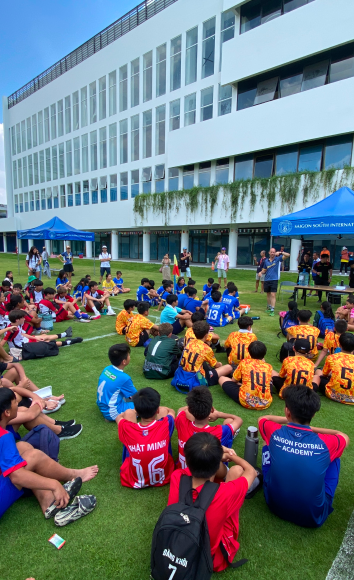
Sessions at this age are about movement, fun and ball-familiarity. Expect lots of small games disguised as activities — “wolves and sheep” with a ball, “traffic lights,” dribbling races, mini goals. Tactical concepts are not introduced. Teamwork is barely touched. The win condition is: did your child come off the pitch smiling and asking when the next session is?
If you watch a Junior session and see kids in straight lines, drilling techniques in silence, walk away. That’s not how 4- and 5-year-olds learn.
Ages 7–10: The “Build” phase
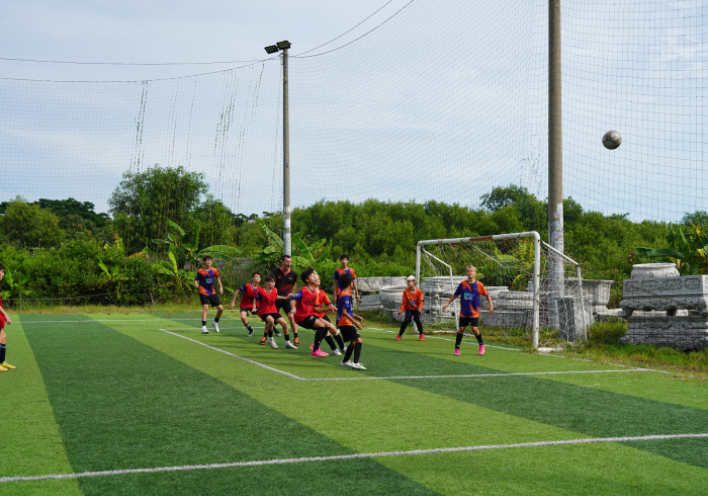
Now technical skills can be layered: passing, receiving, first touch, shooting form, simple defensive shape. Sessions still need plenty of small-sided game time — the ratio of game time to drill time should still be heavily weighted toward games — but kids in this band can absorb instruction and reflect on what worked and what didn’t. Match play in 4v4 and 5v5 formats becomes the centrepiece. Position rotation matters: no one should be “the goalkeeper” at age 8.
Ages 11–14: The “Develop” phase
Tactical understanding kicks in. Players can hold a position, read a press, choose between a long pass and a short one, and start to specialise. Strength and athletic differences widen, so coaching needs to differentiate by ability — not just age. This is the band where competitive seasonal football and proper match calendars start to matter, and where some children commit to football as their primary sport.
Ages 15–17: The “Perform” phase
By 15+, players who have stuck with the game can be coached at high intensity, with proper tactical depth, video review, and competitive pressure. For others, football is one sport among several — both paths are healthy. Senior division work at this stage builds for life-long athletes, not just elite-only pathways.
How to tell your child is ready (and enjoying it)
- They ask when the next session is. The single best indicator. If they’re asking, it’s working.
- They come off the pitch describing one thing they did, not one thing they didn’t. A healthy session creates highlight memories.
- They’re tired in a good way. Hungry, sweaty, slightly buzzed — not overwhelmed.
- They want to bring a friend. Football is profoundly social; this is the ultimate compliment.
How to tell something’s off
- Your child cries before the session and is fine afterwards: usually a coaching-style mismatch, often fixable.
- Your child is silent and withdrawn after sessions: worth raising with the coach immediately.
- Your child is frustrated by being in the wrong group (too easy or too hard): a good academy will move them.
Healthy academies welcome these conversations. If yours doesn’t, that itself is information.
The HCMC factor: why local context matters
Football in Ho Chi Minh City has a few specific considerations that don’t show up in generic guides. The heat is one — sessions need genuine water breaks, shade, and sensible kit choices. School schedules are another — with international, bilingual, and Vietnamese-curriculum schools all running different timetables, finding a session that fits the family week is part of the puzzle. And our community is genuinely mixed, which is part of the magic: kids learn the game alongside peers from very different backgrounds, which builds a kind of confidence that classroom learning rarely matches.
This is why our HCMC academy schedule includes weekend slots, after-school slots and seasonal holiday camps — there’s no single “right time” that works for every family.
The simplest first step: a free trial
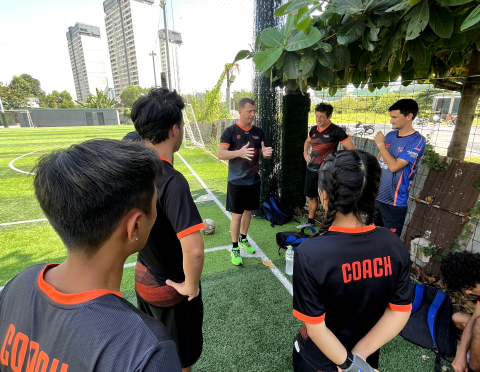
A 60-minute trial tells you more than a 60-page guide. You’ll see your child interact with the coach, with the other players, and with the ball — and within ten minutes you’ll know whether this is the right environment.
To book a free trial at Fox Football, message us via the Contact page, email info@foxfootballvietnam.com, or call +84 90 520 40 73. Share your child’s age, any football experience, and your preferred day — we’ll match them to the right group and the right coach.
Frequently asked questions
Can a 3-year-old start football?
Some can, most can’t sustain a structured session yet. We recommend revisiting at 4 — and in the meantime, plenty of unstructured ball play with a parent at home or in the park.
Is it too late to start football at 12 or 13?
Absolutely not. Skill acquisition at this age is rapid, and the social side of football is in many ways more rewarding for older starters. Our Senior Division regularly welcomes new players in their early teens.
What about girls’ football in HCMC?
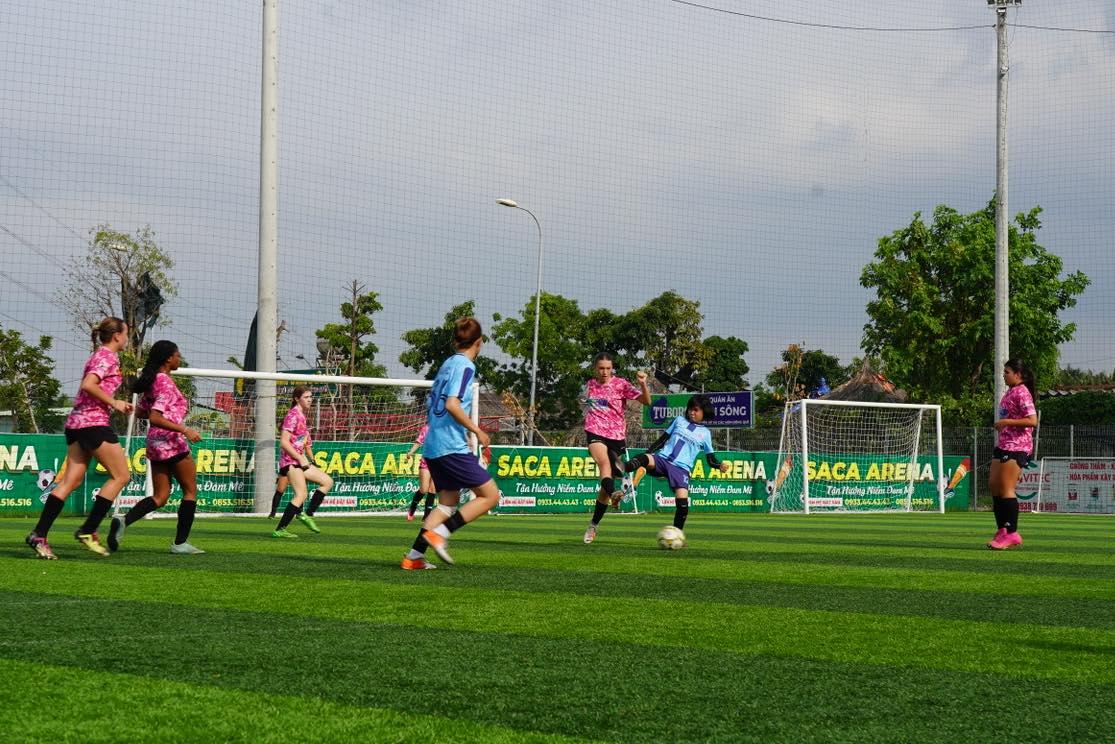
Our classes are mixed and welcome girls and boys equally. Many of our most committed players are girls, and the women’s game globally is at its strongest moment ever — there’s never been a better time to start.
How often should my child train?
One session a week is plenty for the Junior division. From the Intermediate level upward, two sessions per week (one technical, one game-focused) is the sweet spot for most kids. Three or more is for the most committed players or those preparing for a specific tournament.